

Funeral programmes and brochures in Ghana: Content and layout
September 18th 2026, 12:00 am
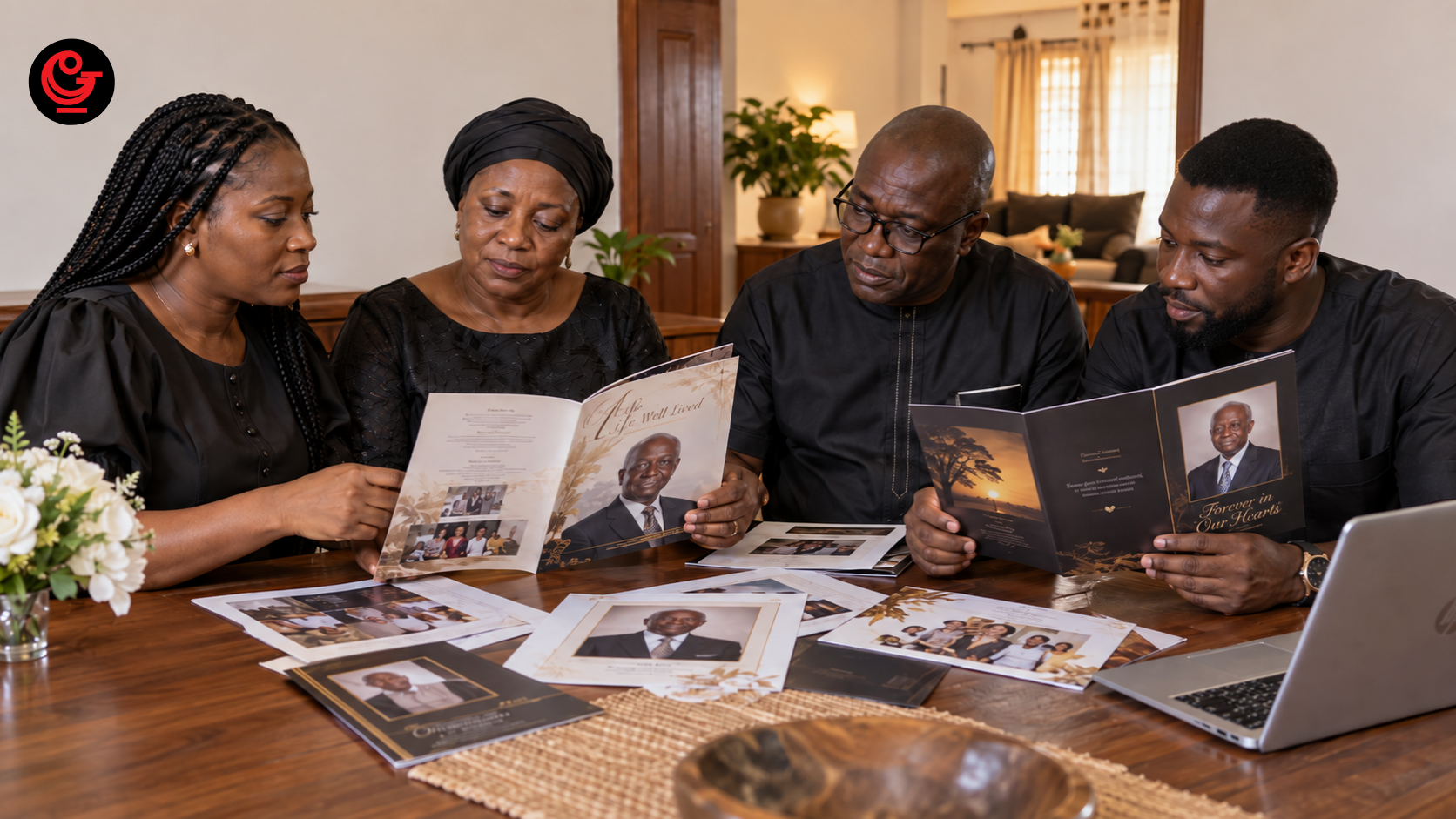
A funeral programme helps people follow the service. A funeral brochure does something more: it can also preserve the story, photographs, tributes and memories of the person being honoured.
In Ghana, both can play an important role during a funeral.
Families may need to organise hymns, readings, tributes, biographies, photographs and service details within a short period. When several relatives are contributing information, mistakes and duplication can easily occur.
A well-prepared funeral programme in Ghana should therefore begin with structure, not design.
This guide explains what sections to include, how to arrange them, how families should review the content and how to prepare the final material for print and digital use.
Funeral programme or funeral brochure: what is the difference?
The two terms are often used together, but they do not always describe the same thing.
A funeral programme primarily guides attendees through the service.
It usually contains:
order of service;
hymns;
prayers;
readings;
officiants;
service details.
A funeral brochure can contain the programme but normally goes further.
It may also include:
biography;
tributes;
family information;
photographs;
acknowledgements;
memories from different stages of life.
Ghana Memorial Products currently separates these two ideas. Its Funeral Programme is part of the paid Ghana Memorial and can be shared online or exported as a simple printable programme. The separate Funeral Brochure product is designed as a fuller web-to-print publication.
Start with the order of the brochure
Before choosing colours or fonts, agree on the sections.
A practical order is:
Cover
Funeral details
Order of service
Hymns and readings
Biography
Tributes
Photographs and memories
Family acknowledgements
Appreciation message
Back cover
Not every family needs all ten sections.
A simple funeral may use a short programme, while a larger brochure may contain several pages of biography, photographs and tributes.
The important thing is to decide the structure before different family members begin sending material.
1. Cover page
The cover should immediately identify the person being remembered.
Include:
full name;
preferred title;
portrait;
date of birth;
date of death;
funeral date, where appropriate;
short remembrance phrase.
Avoid placing too much information on the cover.
The portrait and name should remain the strongest elements.
2. Funeral details
The next section can provide the essential practical information.
For example:
date;
time;
church or service venue;
burial location;
thanksgiving service.
These details should match the family's approved Funeral Announcement.
If different versions of the date or venue are already circulating, resolve them before sending the brochure for printing.
3. Order of service
The order of service should be prepared in consultation with the church, officiant or person responsible for conducting the funeral.
A typical structure may include:
procession;
opening prayer;
hymn;
scripture reading;
biography;
tributes;
sermon or address;
prayer;
announcements;
final commendation;
recessional.
The exact order will depend on the family's religious and cultural arrangements.
Do not copy an old programme and assume the same sequence applies.
Confirm the final order with the officiating church or service leader.
4. Hymns, prayers and readings
Only include material that has actually been selected for the service.
Check:
hymn titles;
hymn numbers;
scripture references;
names of readers;
prayer sections.
If full hymn lyrics are being reproduced, the family or designer should also consider whether permission is required for copyrighted material.
Where space is limited, hymn numbers and titles may be enough if the congregation will use hymn books or projected text.
5. Biography of the deceased
The biography is often one of the most important sections of the funeral brochure.
A useful structure is:
birth and family background;
childhood;
education;
career or working life;
marriage and family;
faith or community life;
interests;
later years;
legacy.
Try to write a life story rather than a list of dates.
At the same time, keep it factual.
Check names, schools, workplaces, positions and dates with relatives who know the information directly.
6. Tributes
Tributes may come from:
spouse;
children;
siblings;
grandchildren;
extended family;
church;
employer;
colleagues;
associations;
friends.
Set a word limit before asking people to submit their tributes.
Without a limit, one tribute may fill several pages while others have little space.
A clear instruction such as 150–250 words per tribute can make the final brochure easier to manage.
The family should also decide which groups will receive their own tribute and which can be combined.
7. Photographs and memories
Photographs can turn the brochure into something people return to after the funeral.
Consider including images from:
childhood;
school;
marriage;
family gatherings;
work;
church;
community activities;
birthdays or celebrations;
later years.
Where possible, add short captions.
A caption such as “With her grandchildren at her 70th birthday” gives future readers more context than an unexplained photograph.
Image quality matters
One of the most common brochure problems is poor image quality.
A photograph can look clear on WhatsApp but become blurry when printed.
For better results:
ask family members for the original image;
avoid screenshots where possible;
do not repeatedly forward and re-save photographs;
avoid heavily compressed social-media images;
use clear photographs where faces are in focus;
send the highest-resolution version available.
If an old printed photograph is important, have it scanned carefully rather than photographing it casually in poor light.
Before printing, ask the designer or printer to flag images that may reproduce badly.
8. Acknowledgements and appreciation
The brochure can include a short acknowledgement section thanking those who supported the family.
This may mention:
church;
extended family;
employers;
associations;
friends;
neighbours;
funeral service providers.
Keep this section concise.
For a fuller thank-you message after the funeral, families can use GMP's separate Funeral Appreciation Card or appreciation-message guidance.
Family review should happen before printing
A funeral brochure can involve many contributors, but final approval should not involve an unlimited number of people.
Appoint a small review group.
Ideally, one person should be responsible for collecting comments and confirming the final version.
Use a checklist covering:
deceased's name;
dates;
family names;
titles;
church details;
order of service;
hymn references;
biography facts;
tribute names;
captions;
telephone numbers;
spelling and punctuation.
Then create a clear status:
FINAL APPROVED VERSION
Once that version is approved, do not allow older drafts to be sent to the printer.
Review the printed proof
Whenever possible, check a proof before the full print run.
Look for:
text that is too small;
photographs that print darker than expected;
cropped heads or faces;
missing pages;
duplicated pages;
wrong page order;
spelling errors;
poor margins;
unreadable captions.
Also check the folding and binding.
A brochure can look correct as separate digital pages but produce the wrong sequence once folded and printed.
Print and digital versions can work together
Families do not necessarily need to print one brochure for every person who may want to see it.
A digital version can be shared through:
WhatsApp;
email;
family groups;
diaspora networks;
the Ghana Memorial.
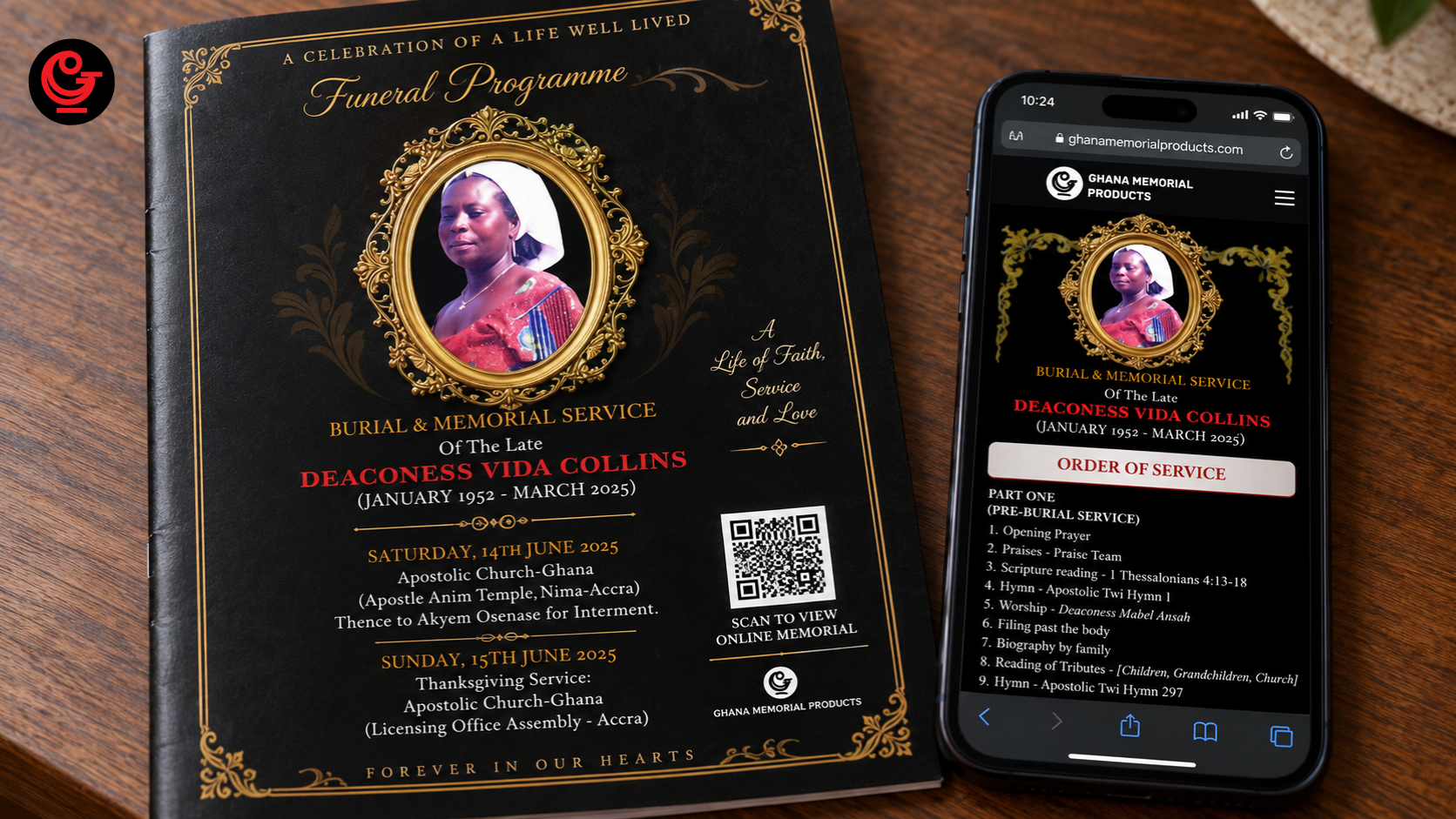
The GMP Funeral Programme currently allows families to maintain service information online, share it by link or QR code and export a simple printable programme.
The Funeral Brochure product is designed around fuller brochure creation, uploaded or template-based designs, QR connections and web-to-print functionality, although GMP's current pricing page marks that web-to-print brochure product as not yet available.
This means the family can still plan the brochure content now while checking current product availability before starting the web-to-print process.
Connecting the brochure to the Ghana Memorial
A printed brochure has limited pages.
A Ghana Memorial can continue where the brochure ends.
The family can preserve:
more photographs;
videos;
audio;
stories;
life milestones;
tributes;
funeral information.
A QR code can connect printed material to that digital memorial.
The brochure becomes the physical keepsake.
The Ghana Memorial becomes the place where the story can continue.
Because memories deserve more than paper.
Finding a printer
Where families need professional printing, Ghana Funeral Services can help them find relevant service providers.
GFS currently has live printing-related provider profiles. Families should compare printers on turnaround time, paper quality, finishing, binding, print quantity and proofing rather than choosing only on price.
Useful questions include:
Can you print this page count and finished size?
What paper options do you recommend?
Is a printed proof available?
What binding or folding method will be used?
How long will production take?
Can you handle additional copies at short notice?
Is delivery included?
What file format do you need from the designer?
The family should send the printer only the approved final artwork.
A good brochure begins with organisation
A meaningful funeral brochure does not begin with decoration.
It begins with accurate information.
Agree on the sections. Confirm the service order. Collect the biography and tributes. Gather the best available photographs. Review everything as a family. Then approve one final version for digital sharing and print.
The result can guide people through the funeral while also preserving something the family may keep for years.
Related Articles
Creating funeral brochure covers in Ghana: Honouring a life lived
Browse the post to know more and explore detailed insights on this topic.
Read MorePhysical and Online condolence books in Ghana: Preserving words of comfort
Browse the post to know more and explore detailed insights on this topic.
Read More