

Funeral banners in Ghana: Purpose, sizes and wording
September 11th 2025, 12:00 am
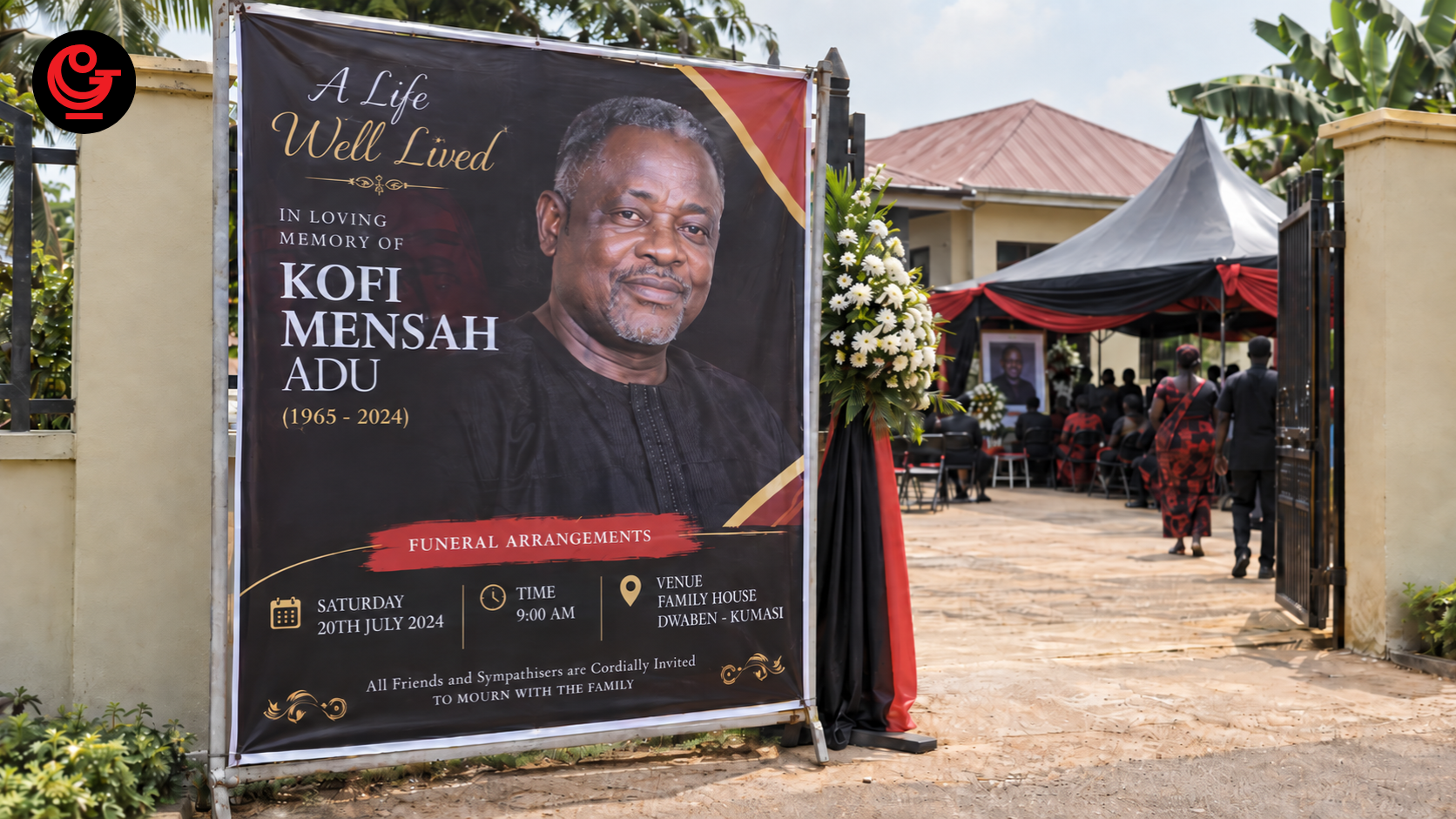
A funeral banner is designed to be seen. Placed at a family house, church entrance, funeral grounds or another visible location, it announces the death of a loved one and helps people recognise where funeral activities are taking place.
Unlike a smaller funeral poster or invitation card, a funeral banner is usually created for visibility from a distance. That changes how it should be designed. The portrait needs to be clear, the name prominent, and the most important funeral information easy to read without standing directly in front of it.
This guide explains the purpose of funeral banners, practical size considerations, where they are commonly placed and what wording families should include.
What is a funeral banner?
Funeral banners are large-format visual notices featuring the deceased and information about the funeral.
Research on funeral banners in southern Ghana describes them as large-scale obituary images commonly displayed in public spaces, often printed on PVC. Their visibility gives the deceased a continued public presence while also communicating the funeral to the community.
A banner may therefore serve several purposes at once.
It can announce the death, identify the funeral venue, honour the deceased and help guests find the correct family house or funeral grounds.
This is what distinguishes it from many smaller funeral materials: a banner is designed primarily for public visibility.
Funeral banner or funeral poster: what is the difference?
The terms are sometimes used interchangeably in Ghana, and printers or families may use them differently.
However, it is useful to separate their main purposes.
Format | Main purpose | Typical use |
|---|---|---|
Funeral banner | Large-scale visibility and public communication | Family house, church entrance, funeral grounds, roadside or venue |
Funeral poster | Announcement and funeral information | Walls, noticeboards, shops, churches and digital sharing |
Funeral invitation | Direct invitation to an individual or group | Printed card, WhatsApp or direct digital communication |
Funeral Announcement | Full communication of confirmed funeral arrangements | Print and digital |
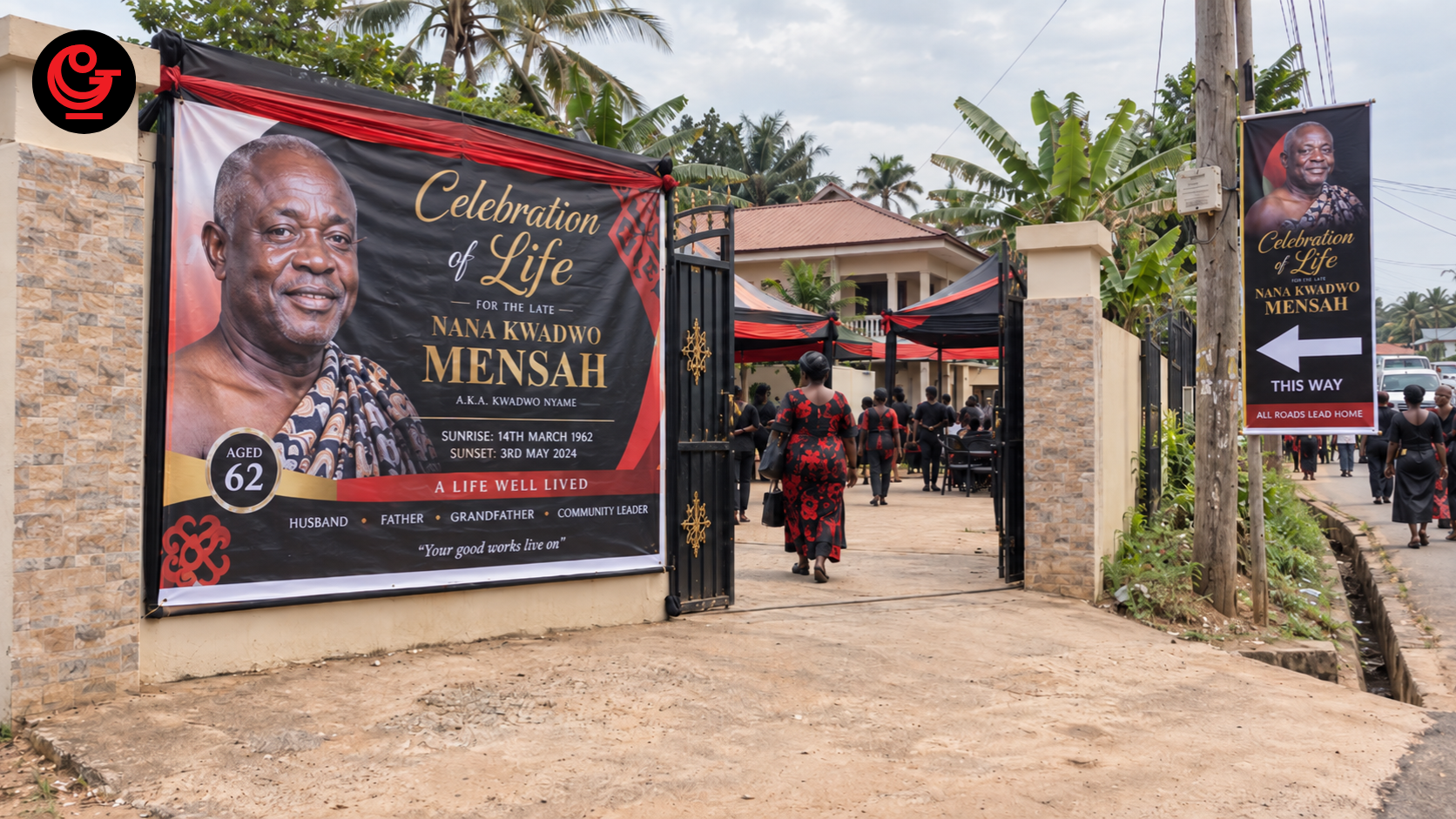
Where are funeral banners used?
The location should influence both the banner size and the amount of information on it.
At the family house
A banner at the family home can identify the location where relatives and sympathisers should gather.
It may remain in place through the one-week observance and funeral period, depending on the family's arrangements.
The deceased's portrait and name are especially important here because the banner helps visitors immediately identify the family they have come to support.
At a church entrance
A church banner can identify the funeral service and welcome mourners arriving at the venue.
In this setting, the most useful information is usually the deceased's name, photograph and the funeral or thanksgiving service details.
There is rarely a need to reproduce every detail of the wider funeral programme on the banner.
At the funeral grounds
At a large funeral, banners may be visible around the main venue.
They can act as memorial displays while also helping attendees identify entrances, family areas or specific activities.
At a junction or along a route
A banner positioned where people need to make a turn has a different job.
It should function almost like a directional sign.
That means less text.
A portrait, name, short funeral reference and a clear directional element can be more effective than a full funeral announcement.
Research on Ghanaian funeral banners specifically notes their visibility at junctions and other public locations where they attract the attention of people moving through the community.
What size should a funeral banner be?
There is no single national standard funeral-banner size in Ghana.
The correct size depends on:
where it will be placed;
how far away people will view it;
whether it is portrait or landscape;
how much information is required;
the structure it will be attached to;
the printing equipment and material available.
For practical context, one Accra printer currently offers banner sizes ranging from 3 ft × 4 ft through 4 ft × 6 ft, 6 ft × 8 ft, 6 ft × 10 ft, 6 ft × 12 ft and 8 ft × 12 ft, in both portrait and landscape orientations. These are examples of commercially available sizes, not official Ghanaian standards.
A useful way to think about size is:
Use | Size approach |
|---|---|
Indoor or small entrance | Smaller banner where people will pass close by |
Family house frontage | Medium format that can be recognised from across the road |
Church or funeral-ground entrance | Medium to large format with prominent name and portrait |
Large outdoor venue | Larger format suitable for longer viewing distance |
Directional banner | Size based on road visibility, but with very little wording |
Ask the printer to confirm the final dimensions before the designer prepares the artwork.
Changing the proportions after a design has been completed can distort photographs, reduce text size or create unnecessary space.
Portrait or landscape?
Both formats can work.
A portrait banner is useful where vertical space is available, such as beside a church entrance, on a wall or close to a doorway.
A landscape banner can work better across a fence, stage area, venue entrance or wider roadside position.
The location should therefore be chosen before the design is finalised.
Do not design first and then search for somewhere to place the banner.
What wording should appear on a funeral banner?
A banner needs fewer words than a funeral brochure or full announcement.
People may see it from a car, across a road or while walking towards the venue.
The most important wording is usually:
FINAL FUNERAL RITES
Late Madam Akua Mensah
1946–2026
Saturday, 19 September 2026
8:00 am
Family House, Aburi
All friends and sympathisers are respectfully invited.
That may be enough.
If the banner is being used mainly to identify a venue, it can be even shorter:
FINAL FUNERAL RITES
Late Opanyin Kofi Asare
Saturday, 19 September 2026
THIS WAY →
The complete funeral arrangements can be communicated through the Funeral Announcement, WhatsApp message, funeral programme or Ghana Memorial.
Wording should match the banner's purpose
Different banners may require different information.
Banner purpose | Information to prioritise |
|---|---|
General funeral announcement | Portrait, name, funeral date, time and venue |
Venue identification | Portrait, name and funeral reference |
Directional banner | Name, event and clear direction |
Church entrance | Name, photograph and service details |
One-week observance | Name, photograph, one-week date, time and venue |
Memorial display | Large portrait, name, dates and short remembrance phrase |
This avoids the common mistake of using one overcrowded design for every location.
Keep the wording readable from a distance
The larger the banner, the more tempting it can be to fill the available space.
That does not mean you should.
A banner carrying ten family names, multiple church affiliations, an extended biography, several scriptures and every funeral activity may become difficult to understand.
The visual priority should normally be:
Portrait → Name → Occasion → Date → Venue
Supporting details come after that.
If people need to stand directly in front of the banner and study it to find the funeral date, there is too much information.
Common banner mistakes to avoid
Before printing a funeral banner, check these eight points:
Do not use a low-resolution photograph. Enlargement makes poor-quality images more obvious.
Do not make the deceased's name too small.
Do not overload the banner with the full funeral programme.
Do not finalise the artwork before confirming the physical size.
Do not use small decorative fonts for essential information.
Check dates, times and venue names carefully before printing.
Think about viewing distance when deciding text size.
Make sure the chosen orientation fits the actual location.
One family representative should approve the final design before it goes to print.
Printed banner and digital funeral communication
A physical banner is very effective within the community, but its reach is geographical.
A relative in Kumasi may see it.
A daughter in London or cousin in Toronto probably will not.
Digital funeral communication therefore complements the banner rather than replacing it.
The same approved information can be used in the Ghana Memorial Products Funeral Announcement, which can be shared digitally with relatives, church groups, associations and diaspora family members.
Families who want practical guidance on the full wording of that communication can see Funeral Announcement in Ghana: Sample, Wording and What to Include.
Connect the banner to a Ghana Memorial
A banner is temporary by nature. It is displayed for the funeral period and eventually comes down.
A Ghana Memorial can continue the remembrance by preserving photographs, stories, tributes, funeral information and other memories online.
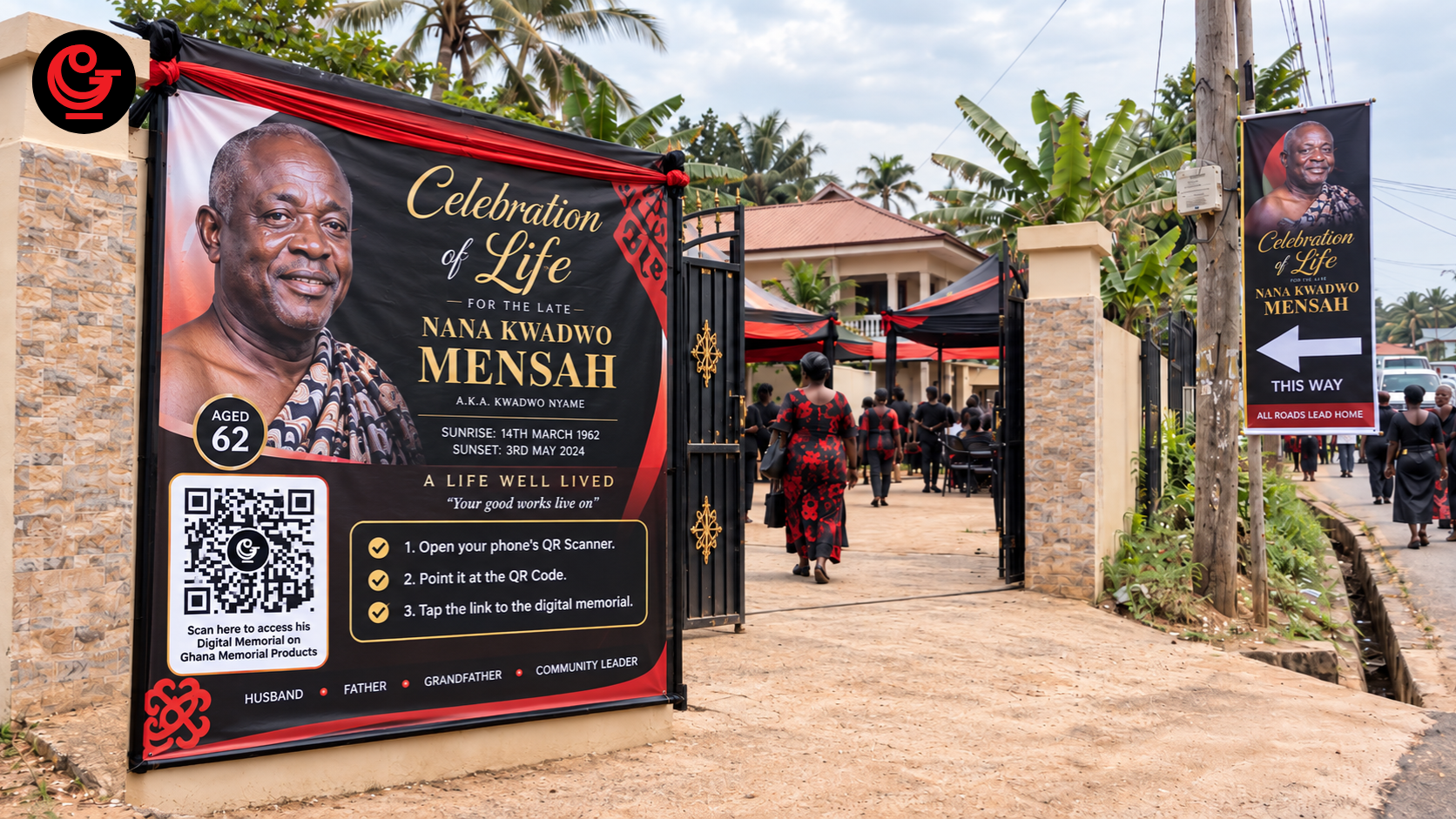
Where appropriate, a QR code on a banner or related printed material can direct visitors to the digital memorial.
Someone arriving at the funeral can therefore move from seeing the public announcement to discovering more about the life being remembered.
Choose the banner for the place
A good funeral banner begins with a practical question:
Where will people see it?
That answer should guide the size, orientation, wording and amount of information.
A banner at a junction needs to be understood quickly. A banner at the family house can carry slightly more information. A memorial banner at the funeral grounds may give greater prominence to the portrait.
The objective is not to fit everything onto one large piece of material.
It is to make the deceased recognisable, communicate what people need to know and help the community participate in the farewell with dignity.
Written by: David Owusu Asante
Related Articles
Keeping the diaspora connected: Digital tools in Ghanaian funerals
Browse the post to know more and explore detailed insights on this topic.
Read MoreWorking with the church during funeral planning in Ghana
Browse the post to know more and explore detailed insights on this topic.
Read More