

Funeral poster design in Ghana: Layout, wording and templates
September 9th 2025, 12:00 am

Funeral Invitation in Ghana: Wording, Design and Common Mistakes
Receiving a funeral invitation in Ghana carries meaning beyond the date and venue printed on it.
It is a call to family, friends, neighbours, colleagues and the wider community to come together, support the bereaved and honour the person who has died.
Today, a funeral invitation in Ghana may be a printed card, a funeral poster, a WhatsApp image or a digital Funeral Announcement. Whatever the format, the purpose remains the same: to communicate the funeral arrangements clearly and respectfully.
For families preparing an invitation, three things matter most: the wording, the information and the presentation.
What should a funeral invitation say?
Funeral invitation wording does not need to be elaborate.
A simple structure usually works best:
The family of the late [Full Name] respectfully announces the funeral arrangements for their beloved [mother/father/sister/brother/relative].
Funeral Service
Date: [Day and Date]
Time: [Time]
Venue: [Venue]
Burial: [Location, where appropriate]
Thanksgiving Service
Date: [Day and Date]
Time: [Time]
Venue: [Church]
All family, friends and sympathisers are respectfully invited to join us as we honour and remember [Name].
This wording can be adapted according to the family, church and circumstances.
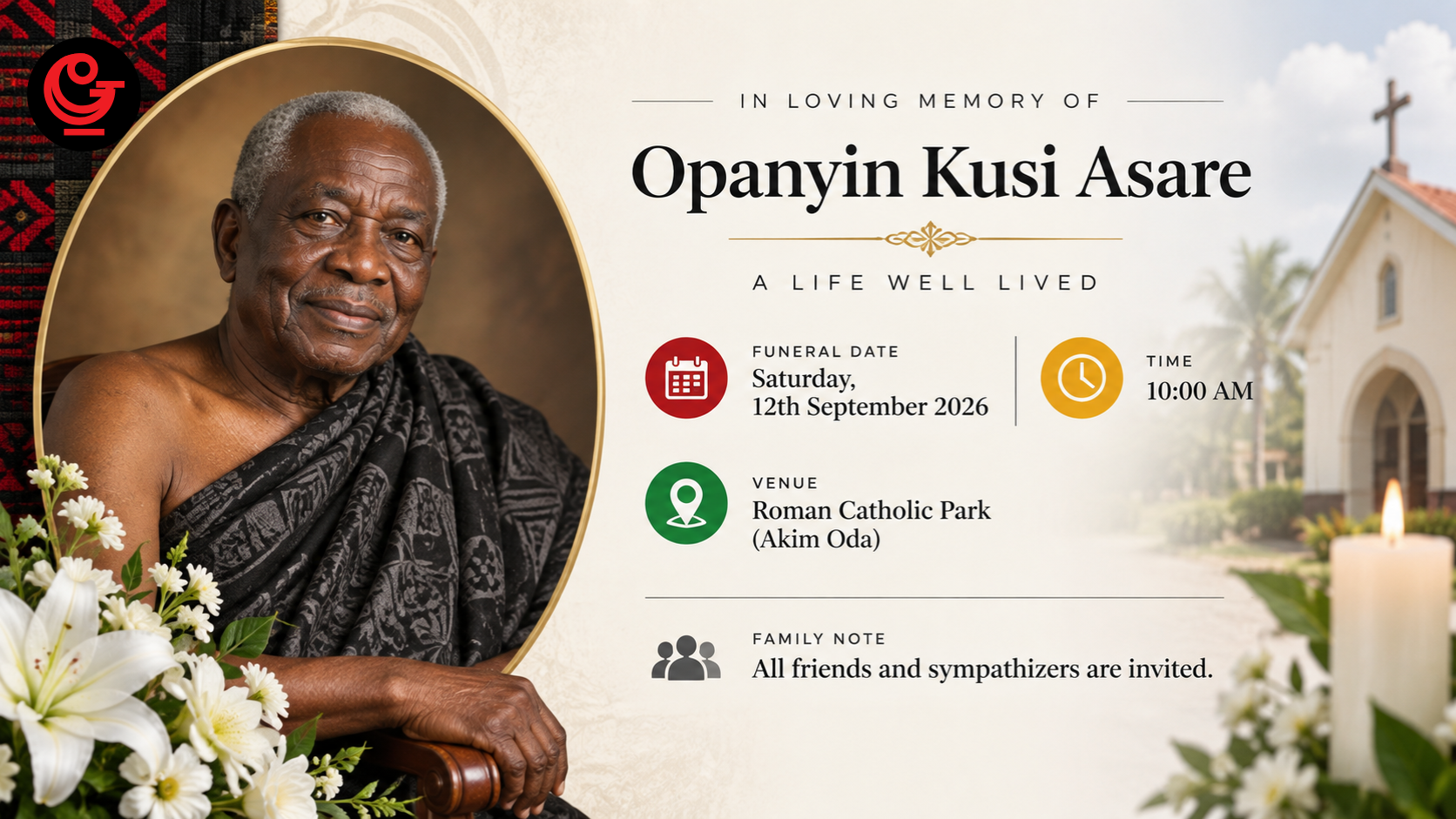
Respectful wording choices for a funeral invitation
Different families prefer different levels of formality.
Formal wording
For a traditional or more formal invitation:
“The family of the late [Name] respectfully invites relatives, friends and sympathisers to the final funeral rites of their beloved [relationship].”
Simple wording
A shorter version can say:
“Please join the family of the late [Name] as we gather to honour and remember their life.”
Church-focused wording
Where the funeral service is centred around a church:
“The family respectfully invites you to join them for the funeral and thanksgiving services of the late [Name].”
Personal wording
For invitations being shared directly with friends or relatives:
“We would be grateful for your presence as we say farewell to our beloved [Name] and celebrate the life we shared with them.”
There is no need to use complicated expressions simply because the occasion is formal.
Respectful and clear wording is more important than elaborate wording.
Information to include on a funeral invitation
Before the invitation is designed, the family should confirm the information that needs to appear on it.
Usually this includes:
Full name of the deceased
Preferred title or name
Portrait photograph
Funeral date
Starting time
Venue
Burial information, where appropriate
Thanksgiving service
Chief mourner or family information, where required
Contact information, if the family wants it published
Some invitations also include information about:
wake-keeping;
dress code;
church affiliation;
family groups or associations;
directions;
livestream;
QR code;
Ghana Memorial.
Only include information that has been confirmed.
It is better to publish a shorter, correct invitation than a detailed invitation containing information that may later change.
Ghanaian funeral invitation design conventions
Funeral invitations in Ghana often have visual characteristics that make their purpose immediately recognisable.
These are conventions rather than strict rules. Family, ethnic, religious and community traditions can differ.
The portrait
The deceased's photograph is usually one of the most prominent elements.
Choose an image that:
clearly shows the person;
has been approved by the family;
is of sufficient quality for printing;
represents the person in a respectful way.
Avoid using a small WhatsApp screenshot for a large printed invitation or poster. It may appear acceptable on a phone but become blurred when enlarged.
Colours
Black and red are strongly associated with mourning in many Ghanaian funeral settings.
Black and white, white, cream and other colour combinations may also be used depending on the age of the deceased, family preference, religious practice and local tradition.
Families should therefore avoid treating any colour rule as universal.
The design should reflect the traditions of the family being represented.
Name and titles
The deceased's name should be easy to find.
Where titles are important to the family or community, these may also be included.
However, avoid placing so many titles, affiliations and descriptions around the name that it becomes difficult to identify the deceased quickly.
Funeral details
Date, time and venue should be visually prominent.
A beautiful invitation that makes the reader search for the funeral date has failed at one of its most important jobs.
Funeral invitation card, funeral poster or Funeral Announcement?
These terms are sometimes used interchangeably, but the format can differ.
A funeral invitation card may be given personally or distributed to a defined group of people.
A funeral poster is generally designed for wider public communication and can be printed in larger sizes or shared digitally.
A Funeral Announcement is the broader communication containing the confirmed funeral arrangements and can be produced for both print and digital use.
Families do not necessarily need three completely different designs.
A consistent design can often be adapted across several formats.
Common funeral invitation mistakes
Families often prepare funeral communication under considerable time pressure. Small mistakes are therefore easy to make.
1. Publishing before the arrangements are confirmed
This can lead to several versions circulating with different dates or venues.
Agree on the information first.
Then designate one person to approve the final invitation before it is shared.
2. Wrong dates or days of the week
Always check the written date against the day.
For example, do not assume that because the funeral is on a Saturday, the typed date must also fall on a Saturday.
Check it before printing.
3. Misspelling the deceased's name
This is one of the most important details on the invitation.
Check all names and titles carefully with the immediate family.
4. Too much information
Trying to include every family member, association, church, title and funeral activity can make an invitation difficult to read.
Prioritise the information the recipient actually needs.
More detailed family history and biographical information can be placed in the Funeral Brochure or Ghana Memorial.
5. Poor-quality photographs
Low-resolution images can produce poor printed results.
Where possible, locate the original photograph before the designer begins.
6. Text that is too small
A design may look attractive on a designer's large computer screen but become difficult to read on WhatsApp.
Check the finished version on a mobile phone.
The deceased's name, funeral date, time and venue should remain clear.
7. Too many fonts and decorative elements
The design should support the message, not compete with it.
Use a clear visual hierarchy and keep decorative elements controlled.
8. Sharing different versions
Once the invitation has been approved, clearly identify the final version.
Family members should share that version rather than older drafts.
9. Forgetting relatives abroad
Digital sharing allows families to inform people outside Ghana quickly.
Prepare a version that can be sent directly through WhatsApp, email and social media instead of relying only on photographs of the printed invitation.
Print and digital invitations can work together
Digital invitations have not made printed funeral communication unnecessary.
The two can complement each other.
Printed invitations and posters are useful for:
churches;
neighbourhoods;
workplaces;
family houses;
community notice areas;
people who prefer physical communication.
Digital invitations can reach:
diaspora relatives;
WhatsApp groups;
former colleagues;
old students' groups;
church members;
friends living in other regions.
A family can therefore approve the information once and use it across both channels.
Tradition does not have to be replaced by technology. Digital tools can simply extend its reach.
Creating the invitation with Ghana Memorial Products
Families who are ready to move from wording to the actual design can use the Ghana Memorial Products Funeral Announcement.
The current GMP Funeral Announcement allows families to use customisable templates, reuse an earlier design or upload their own design.
The finished announcement can then be shared digitally or prepared for print.
Connect the invitation to further funeral information
A printed invitation has limited space.
A QR code can give guests access to additional information without filling the design with too much text.
Depending on the family's choices, it can connect to:
an Online Condolence Book;
a Donation Link;
the Ghana Memorial;
other digital funeral information.
GMP's current Funeral Announcement supports QR-code connections to the Online Condolence Book, Donation Link and Ghana Memorial.
This can be particularly helpful for relatives abroad or guests who want to return to the information later.
An invitation should make participation easier
The best funeral invitation does not need to be the most elaborate.
It should allow someone to look at it and quickly understand:
Who has died? When is the funeral? Where should I go? What time should I be there?
Everything else supports those answers.
A respectful photograph, appropriate wording and Ghanaian design conventions help honour the deceased. Clear information helps the community show up.
Together, they allow the invitation to carry both practical information and the weight of the occasion.
Written by: David Owusu Asante
Related Articles
Appreciation messages after a funeral in Ghana
Browse the post to know more and explore detailed insights on this topic.
Read MoreCreating funeral brochure covers in Ghana: Honouring a life lived
Browse the post to know more and explore detailed insights on this topic.
Read MoreLetter of appreciation to church after funeral in Ghana
Browse the post to know more and explore detailed insights on this topic.
Read More