

Roles in funeral planning: How families can organise tasks after the death of a loved one
October 6th 2026, 12:00 am

After a death, many decisions can arrive at the same time.
Relatives need to be informed. Documents must be handled. The family may need to speak with the mortuary, church, cemetery and funeral service providers. Someone has to manage money, announcements, photographs, tributes and the programme.
Trying to let everybody manage everything can quickly create confusion.
A more practical approach to funeral planning in Ghana is to agree early on who is responsible for each area, while keeping the important decisions with the appropriate family members.
This guide explains useful family roles, how to divide responsibilities and how Ghana Memorial Products can help the family keep tasks, information and funeral details organised in one place.
Funeral roles are not the same in every Ghanaian family
Ghanaian funeral traditions vary between families, ethnic groups, religious communities and regions.
There is therefore no single national rule saying that every funeral must have the same committee structure or that a particular relative must perform a particular planning role.
Some families work through elders and an extended-family structure. Others establish a formal funeral committee. In smaller families, a few people may share several responsibilities.
The aim should not be to create unnecessary titles.
It should be to make sure that every important responsibility has a clear owner.
A practical funeral-planning team
A family can adapt the following structure to its circumstances.
Role | Main responsibility | When to assign |
|---|---|---|
Family representative / Chief Mourner | Represents the family and helps confirm major decisions | As early as the family's customs allow |
Planning coordinator | Keeps the overall funeral plan and responsibilities together | Early in planning |
Documentation coordinator | Tracks death registration, burial documentation and official paperwork | Immediately |
Finance & contributions coordinator | Budget, expenses, donations and records | Early in planning |
Religious/service coordinator | Church, mosque, clergy and order of service | Once the form of service is agreed |
Communications coordinator | Notices, invitations and confirmed information | Once key details are approved |
Programme & remembrance coordinator | Biography, tributes, photographs and programme content | During preparation |
Logistics coordinator | Venue, transport, tents, chairs and provider coordination | Once date and venue become clear |
Digital memorial coordinator | Ghana Memorial, online updates, livestream and digital family contributions | During planning |
One person can hold more than one role in a smaller funeral. For a large funeral, each area may need several people.
Family representative or Chief Mourner
In some Ghanaian families, a Chief Mourner or another recognised family representative has an important ceremonial and representative role.
Who fulfils that role and how the person is selected can depend on family and customary practice.
Avoid assuming that it must always be the spouse, eldest child or oldest relative.
For planning purposes, what matters is that the family knows who has authority to confirm important decisions.
That person should not necessarily have to perform every administrative task.
A good structure allows the family representative to concentrate on important decisions while other people manage documentation, suppliers, finance and communications.
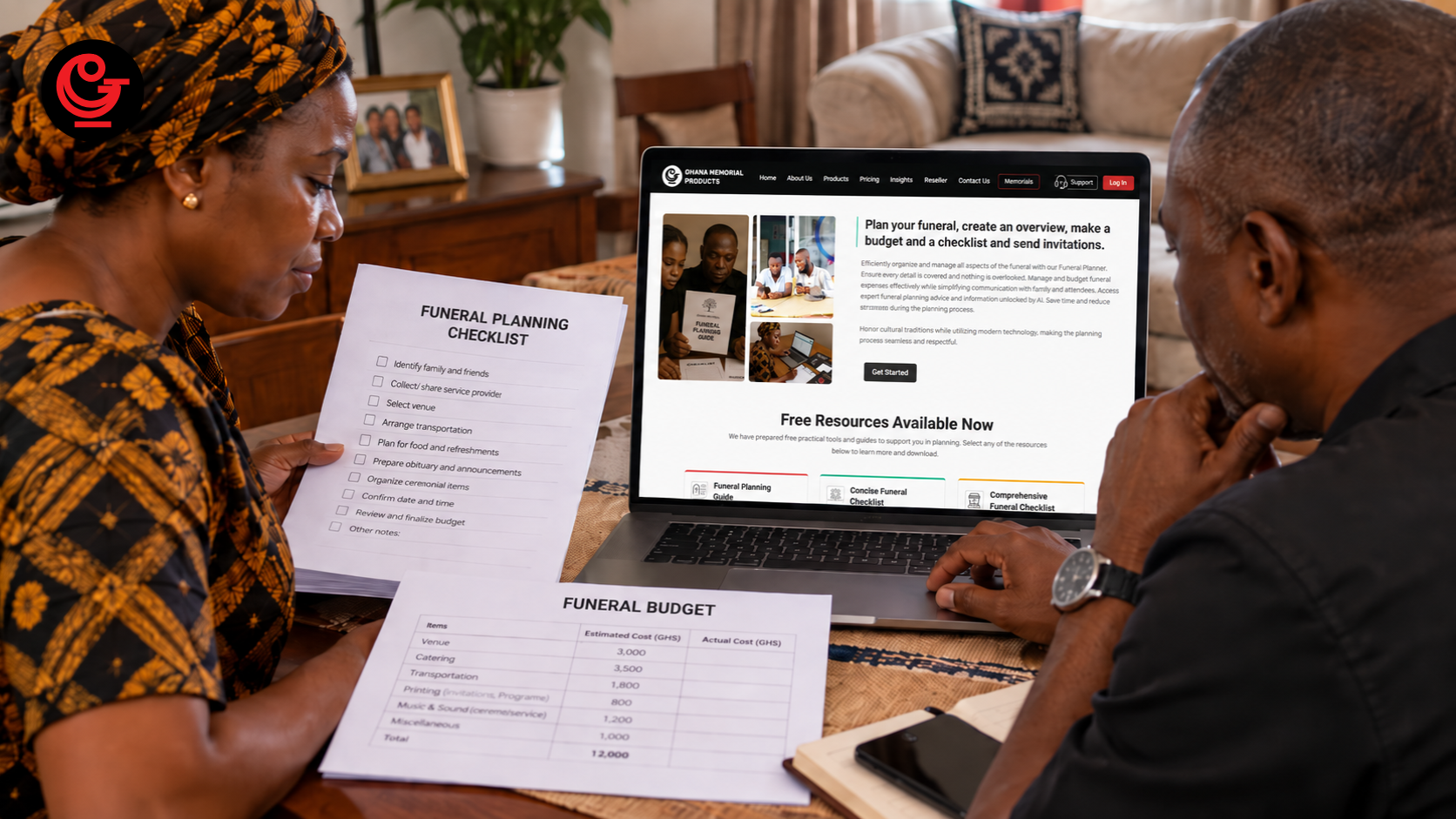
Planning coordinator
The planning coordinator keeps the different parts of the funeral connected.
This person should know:
what has been decided, what is still outstanding, who owns each task, which deadlines matter and where the latest information can be found.
They are not expected to do everything personally.
Their job is to prevent tasks from being forgotten or duplicated.
The Ghana Memorial Products Funeral Planner is designed for this purpose. GMP currently provides a Funeral Planning Guide, Concise Funeral Checklist, Comprehensive Funeral Checklist, Funeral Budget Planner and Funeral Expense Tracker as free planning resources.
Using one planning system also helps prevent different relatives from working with different versions of the funeral plan.
Documentation coordinator
Official paperwork deserves its own responsible person.
The documentation coordinator can keep track of matters such as:
death registration, medical documentation, burial permit requirements, mortuary paperwork and other documents relevant to the circumstances.
This role should rely on the responsible authorities rather than family assumptions.
The Ghana Births and Deaths Registry states that deaths are registered in the district where the death occurred. For deaths in a health institution after more than 24 hours of admission, the Registry requires the original medical cause-of-death certificate; different procedures apply for deaths outside health facilities or before 24 hours of admission.
Where circumstances are unusual, the family should confirm the process directly with the relevant authority.
Finance and contributions coordinator
I would combine the old Financial Coordinator and Donation Manager into one role.
Separating them can create two sets of financial records.
The finance and contributions coordinator should maintain a clear picture of the approved budget, money received, payments made, outstanding amounts and who authorised major expenses.
This person should work closely with the planning coordinator.
If the family receives online contributions, GMP's Donation Link is designed to collect funeral support from Ghana and abroad and to help families track contributions in one place. Its activation currently requires KYC information and approval through PaySwitch.
The same principle should apply to cash donations: record them consistently and agree who has access to the money.
Religious and service coordinator
Where the funeral includes a church, mosque or other religious service, one person should act as the main contact.
This person can confirm the service date and time, officiants, readings, hymns or prayers, order of service and any requirements of the religious organisation.
This avoids several relatives contacting the church with different instructions.
Once the details are confirmed, they should be passed to the programme and communications coordinators.
Communications coordinator
One person should control the final funeral information released to relatives and the public.
This includes the One-Week Notice, Funeral Announcement, WhatsApp messages, invitations and other public notices.
The communications coordinator should never publish a date, venue or time simply because it has been discussed.
Use only family-approved information.
GMP's Funeral Programme provides a useful digital source of current funeral information. It supports funeral dates, venue information, dress instructions, programme details and livestream links, and updates can be shared through a link or QR code.
This is particularly useful when relatives are participating from outside Ghana.
Programme and remembrance coordinator
Instead of having an isolated “eulogy writer” role, appoint someone to coordinate the funeral's wider remembrance content.
That may include the biography, tributes, photographs, captions, programme content and family information.
This person should collect material from relatives but should not independently decide what is published.
Names, dates and important biographical facts should be reviewed by the family before printing.
The same material can later contribute to the Ghana Memorial, where families can preserve photographs, stories, tributes, a Life Timeline and other information beyond what fits inside a printed funeral brochure.
Logistics coordinator
This person manages the physical arrangements around the funeral.
Depending on the event, that may include venue access, tents, seating, transport, hearse arrangements, catering, flowers, decoration, sound, photography and other services.
The coordinator should also make sure different providers understand when they can access the venue.
Where outside businesses are needed, Ghana Funeral Services should be used for provider discovery rather than GMP attempting to recommend individual suppliers. GFS is a directory designed to help families find and contact funeral service providers in different categories.
This creates a clear division:
GMP helps the family plan and organise.
GFS helps the family find service providers.
Who coordinates pallbearers?
Pallbearers do not necessarily need a separate planning position.
Their arrangements can normally sit with the funeral director, logistics coordinator or family representative, depending on the funeral.
The family should confirm who will perform the role, whether professional pallbearers are being used and any instructions connected with the church, funeral home or burial.
What matters is that responsibility is assigned rather than assumed.
Add a digital memorial coordinator
This is one role that was missing from the older article.
Funeral information increasingly comes from several relatives, including people living outside Ghana.
A digital memorial coordinator can manage the family's Ghana Memorial and collect approved digital content.
They can help maintain the Funeral Programme, add photographs and stories, manage memorial information, share links with diaspora relatives and coordinate livestream information.
The Funeral Programme is part of a paid Ghana Memorial and is designed to act as a shared source for service information, with live updates, QR sharing and a printable two-page programme.
After the funeral, the focus can shift from organisation to preserving the person's life and the memories of the funeral itself.
One source of truth prevents mistakes
Good delegation only works when everyone is working from the same information.
Imagine three relatives each have a different funeral date saved in WhatsApp.
Another person has changed the church time.
A designer is still working from yesterday's information.
Meanwhile, the catering provider has been given a different expected guest number.
Everyone may be trying to help, but the family still has a problem.
The solution is simple:
one approved plan, one responsible person for each area and one current source of information.
GMP's Funeral Planner and digital Funeral Programme are designed around that principle: keeping tasks, budgets, service information and communication more organised.
The family remains in control
Assigning roles does not mean turning a funeral into a business project.
It means reducing avoidable pressure at a difficult time.
The family can still make important decisions together. Elders can fulfil their customary responsibilities. Religious traditions can be respected. Friends and relatives can contribute.
But everyone should know what they have agreed to handle.
When responsibilities are clear, fewer tasks are forgotten, suppliers receive clearer instructions, financial records are easier to follow, and relatives have a better chance to focus on what matters most: honouring the person who has died.
The tribute they deserve. The peace you need.
Families can begin with the Ghana Memorial Products Funeral Planner, using the planning guide, checklists, budget planner and expense tracker to divide responsibilities and create a clearer overview.
Written by: David Owusu Asante
Related Articles
Setting up a funeral planning committee in Ghana
Browse the post to know more and explore detailed insights on this topic.
Read MoreThe benefits of web-to-print for funeral planning in Ghana
Browse the post to know more and explore detailed insights on this topic.
Read More