

The benefits of web-to-print for funeral planning in Ghana
February 12th 2026, 12:00 am
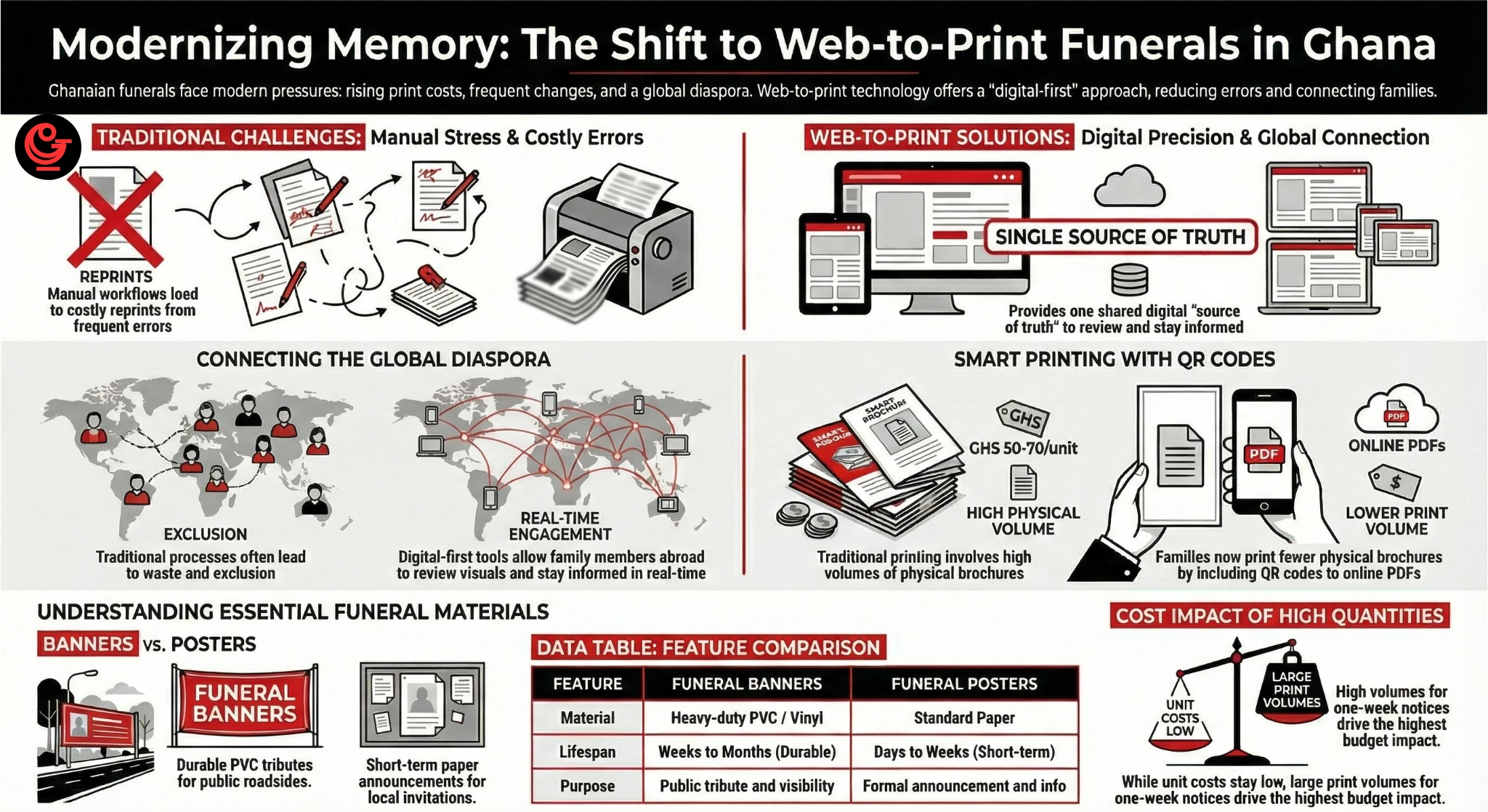
Introduction: Funeral Planning Today – Between Tradition and Pressure
Funeral planning in Ghana sits at the intersection of deep tradition and growing modern pressure. A funeral is not only a family matter; it is a community event that carries social, cultural, and emotional responsibility. Families are expected to inform the wider community, honour the deceased properly, and organise ceremonies within a short period of time.
At the same time, the realities of today make this process more complex. Printing costs have increased, information often changes at the last minute, and many close relatives now live abroad. Families must coordinate decisions across borders while emotions are still raw.
This article explains how web-to-print funeral planning in Ghana helps families manage these pressures. It shows how digital tools can support traditional funeral practices by reducing errors, controlling printing costs, and keeping both local and diaspora family members informed through clear visuals and shared information.
Background: Printed Funeral Materials in Ghanaian Culture
Printed funeral materials have long been central to Ghanaian funeral culture. They serve both practical and symbolic purposes: announcing a death, guiding mourners through ceremonies, and preserving the memory of the deceased.
Items such as funeral banners, one-week notices, posters, programmes, brochures, and appreciation cards are not simply paperwork. They are public expressions of respect and remembrance. Displayed on roadsides, buildings, vehicles, and at funeral grounds, they make loss visible and invite collective support.
However, these materials were developed in a time when information travelled slowly, and changes were rare. Today, details such as dates, venues, and family roles often evolve during the planning process. When everything is printed too early or in large quantities, families face waste, reprints, and unnecessary expense.
Understanding this cultural background is important. Web-to-print does not remove the value of printed funeral materials. Instead, it offers a way to preserve their meaning while adapting their use to today’s realities.
The next section looks at how funeral printing is typically handled today, and why many families experience unnecessary stress, delays, and extra costs during this process.
How the Funeral Printing Process Works Today (Traditional Flow)
Family gathers information manually
Designer creates initial artwork
Proofs shared via WhatsApp screenshots
Bulk printing
Late corrections discovered
Costly reprints and delays
Common challenges:
Errors and last-minute changes
Multiple conflicting versions
Waste from excess printing
Diaspora exclusion from decision-making
What Web-to-Print Means in Funeral Planning
Simple definition of web-to-print
Difference between print-first and digital-first approaches
One digital source feeds print and online sharing
Why this model suits Ghanaian funeral practices
Main Advantages of Web-to-Print for Families
Benefit | Explanation |
Save time | No repeated redesigns |
Reduce stress | Fewer last-minute errors |
Control costs | Print only what is needed |
Better coordination | One shared source of truth |
Diaspora inclusion | Everyone sees the same visuals |
Web-to-Print Funeral Elements Explained
Before looking at each printed item in detail, it is important to distinguish between funeral posters and funeral banners in the Ghanaian context. Although the terms are sometimes used interchangeably, they serve different functions and carry different cultural meanings.
Funeral Banners in Ghana
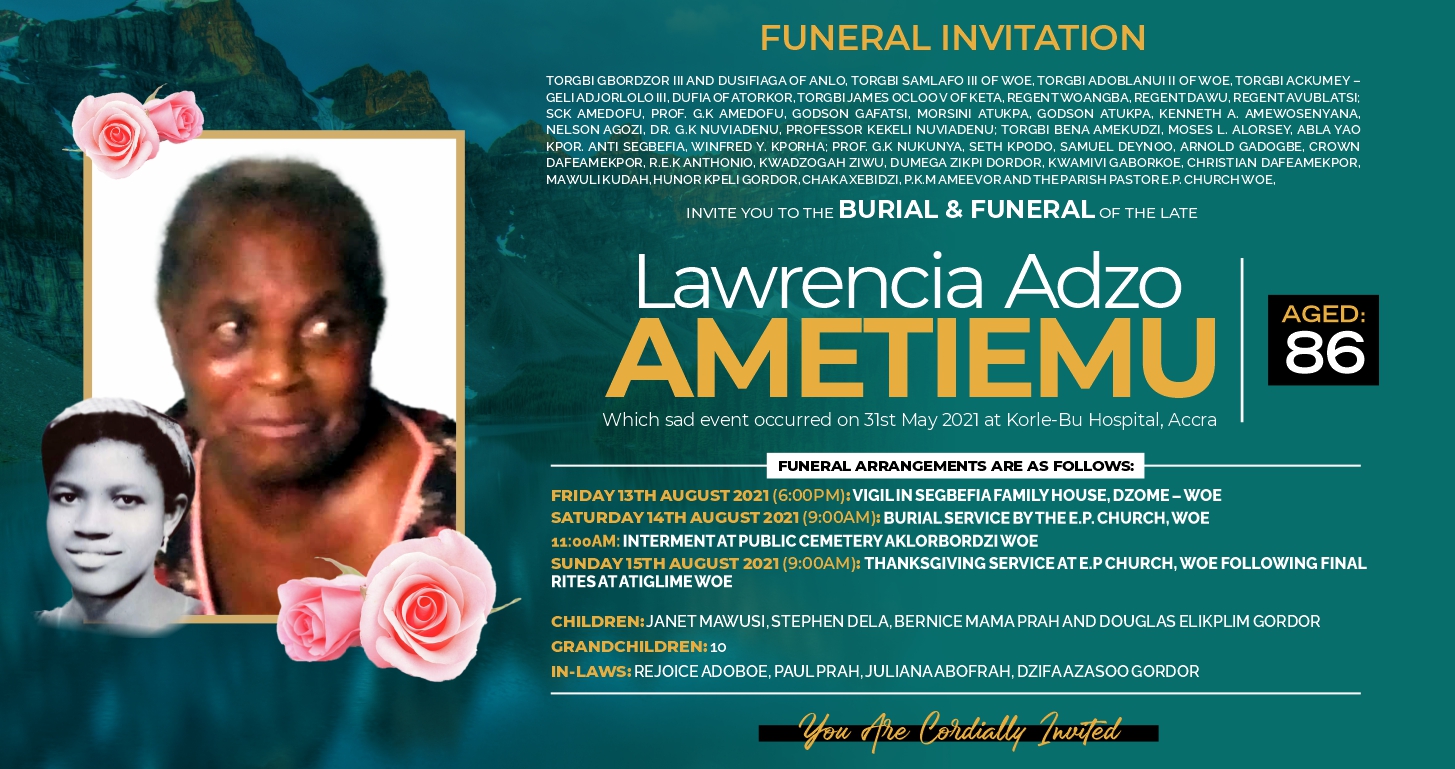
Funeral banners in Ghana are large, durable displays, usually printed on PVC (polyvinyl chloride) or strong fabric. They prominently feature photographs of the deceased and are used to announce a death, honour the departed, and invite the wider community to funeral events.
How funeral banners are used:
Displayed along major roads, junctions, and neighbourhood entrances
Hung on trees, fences, and poles
Positioned at funeral venues and sometimes near the gravesite
Because of their material, banners are weather-resistant and designed to last. In many communities, they function not only as announcements but also as a long-lasting memorial tribute, sometimes remaining in place for weeks or months after the funeral.

Key Differences Between Funeral Banners and Funeral Posters
Aspect | Funeral Banners (Announcement) | Funeral Posters (One-Week Notice) |
Material | Heavy-duty PVC or vinyl | Paper |
Durability | Water-repellent, long-term outdoor use | Short-term, degrades quickly |
Size & Impact | Large-scale, highly visible | Smaller, closer reading |
Purpose | Public tribute and visibility | Formal announcement and invitation |
Typical Lifespan | Weeks or months | Days to a few weeks |
Banners are often described as a public, celebratory tribute, while posters function more as direct announcements that communicate essential funeral details.
Cost Indicators at a Quantity of 300 Copies
To help families make informed decisions, the table below provides estimated unit cost ranges for common funeral print items in Ghana, based on feedback from printers and designers in Ghana. These figures are indicative and may vary by city, print quality, colour use, and paper or material choice.
All ranges below refer to cost per single item, not total cost.
Print Item | Typical Format | Estimated Unit Cost (GHS) | Cost Impact | Practical Notes |
Funeral Banner / One-Week Notice | A3 or A2 paper or PVC | 50 – 70 | High (quantity-dependent) | Costs rise mainly due to large print quantities |
Funeral Announcement (Poster) | Small to A3 | 15 – 25 | Low–Medium (size-dependent) | Often called a funeral poster, size affects cost |
Funeral Appreciation Card | Small card | 15 – 25 | Medium | Frequently underestimated in budgets |
Funeral Donation | Small booklet | 20 – 30 | Low | Usually printed in one or two copies only |
Funeral Program / Brochure | Multi-page booklet | 50 – 70 | Medium–High (quantity-dependent) | Often printed in smaller quantities with QR to an online PDF |
Key observations: - The funeral banner and one-week notice are the same item; the cost impact becomes high mainly due to large quantities, not the unit price alone. - The funeral announcement is commonly referred to as a funeral poster, with cost influenced by size. - Donation receipt booklets have a low cost impact because only one or two copies are typically printed. - Funeral programs are increasingly printed in smaller quantities and supported by QR codes linking to an online PDF. - Web-to-print allows families to balance print and digital use without losing cultural meaning.
More resources can be found at: Funeral Planner
And on our YouTube channel: Ghana Memorial Products
Related Articles
Tombstones in Ghana: Types, Materials, Prices & Timing
Browse the post to know more and explore detailed insights on this topic.
Read MoreDeath and funeral announcements in Ghana: Tradition and modern tools
Browse the post to know more and explore detailed insights on this topic.
Read More