

How to obtain a burial permit in Ghana
September 9th 2026, 12:00 am

When a family begins arranging a burial in Ghana, one legal document that cannot be overlooked is the burial permit.
The process can sometimes be confusing because families may be dealing with a hospital, mortuary, police, Births and Deaths Registry, funeral home and cemetery at the same time.
The most important point is simple: a burial permit in Ghana is issued through the Births and Deaths Registry as part of the official death-registration process. It is not normally a separate permit that a family first applies for at the District Assembly.
This guide explains how to obtain a burial permit in Ghana, the documents involved and which authority is responsible at each stage.
What is a burial permit in Ghana?
Under Ghana's Registration of Births and Deaths Act, 2020 (Act 1027), a burial permit is the official authorisation allowing the burial, cremation or other lawful disposition of a deceased person's body.
For a death occurring in Ghana, the District Registrar registers the death and issues:
the death certificate, for which the prescribed fee applies; and
the burial permit, which is issued free of charge.
The death certificate and burial permit are therefore related, but they are not the same document.
Who issues the burial permit?
The responsible authority is the District Registrar of the Births and Deaths Registry.
The death should be registered in the district where the death occurred.
This corrects a common misunderstanding.
A District Assembly may have responsibilities relating to cemeteries, funeral homes, mortuaries and other disposition facilities in its district. Under Act 1027, District Assemblies are responsible for registering such facilities. However, the burial permit itself is issued by the District Registrar of Births and Deaths.
How to obtain a burial permit in Ghana
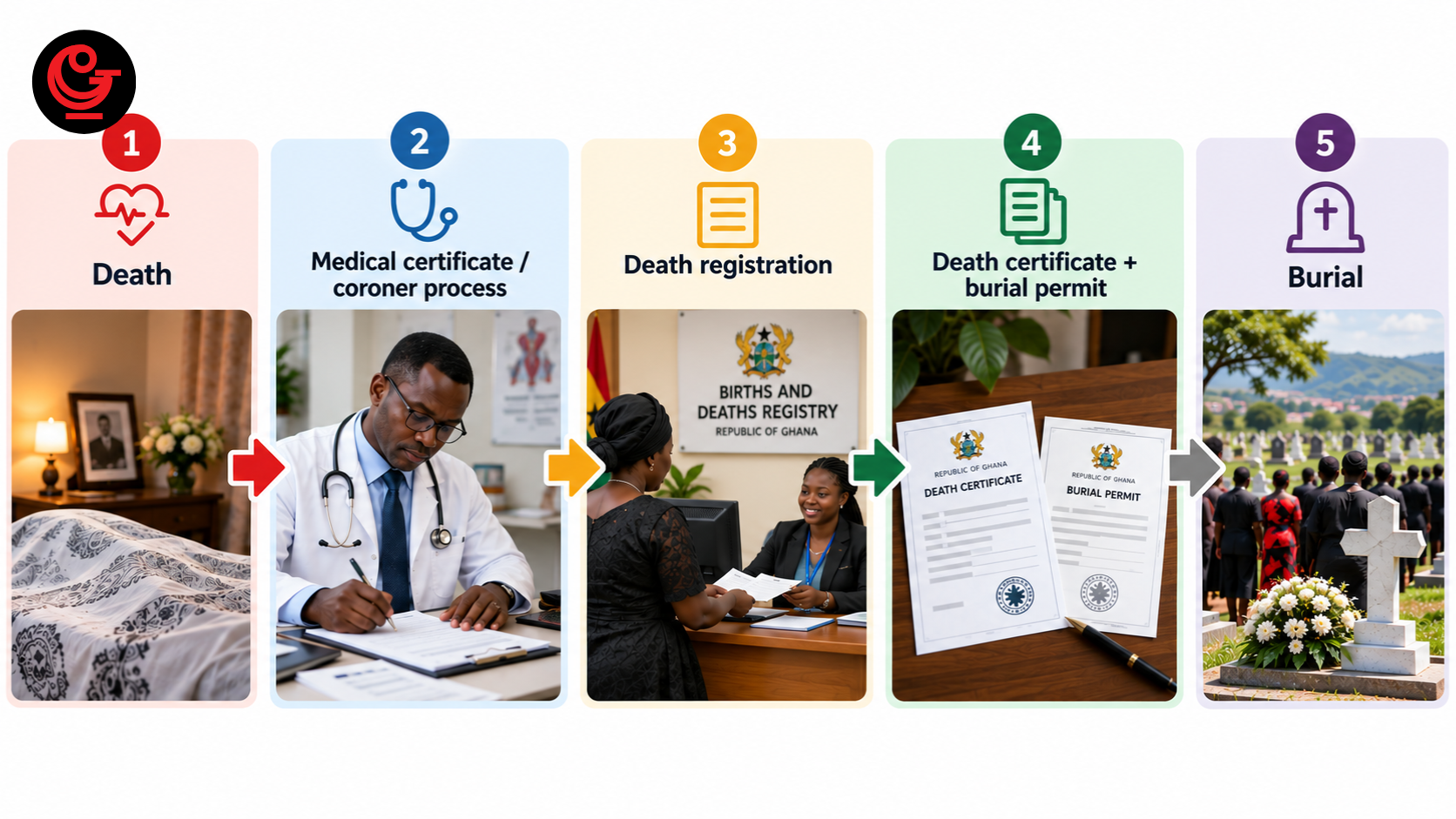
To obtain a burial permit in Ghana, the family must first complete the official death-registration process.
The general process is:
Obtain the appropriate medical cause-of-death certificate or coroner's documentation.
Go to the Births and Deaths Registry office in the district where the death occurred.
Provide the original supporting document and the required registration information.
Complete the death-registration process with the District Registrar.
Receive the official death certificate and burial permit.
Present the burial permit to the cemetery, burial-ground manager or other authorised disposition facility before the burial.
The exact procedure depends on whether the death occurred in a health facility, at home or elsewhere.
If the death occurred in a health facility
For deaths occurring in a health institution after more than 24 hours of admission, the Births and Deaths Registry currently instructs the relative to:
Go to the Births and Deaths Registry office in the district where the death occurred.
Present the original medical cause-of-death certificate.
Provide the details required to enter the death register.
These details include information such as:
name of the deceased;
age;
nationality;
occupation;
address;
name of the informant;
relationship of the informant to the deceased.
Information such as the date, place and cause of death is taken from the medical documentation.
Once the legal requirements for registration have been satisfied, the District Registrar can register the death and issue the death certificate and burial permit.
What if the person died at home or outside a health facility?
The process is different.
The Births and Deaths Registry currently distinguishes deaths occurring outside a health facility or before 24 hours in a health facility.
Its published procedure directs a relative to:
Report the death to the nearest police station.
Allow the police to investigate and initiate the inquest process.
Obtain the resulting coroner's report through the court process.
Present the original coroner's report to the Births and Deaths Registry office in the district where the death occurred.
Supply the required details for registration.
Receive the death certificate and burial permit after the death has been registered.
Act 1027 also provides that where a death requires a coroner's inquiry, the District Registrar cannot register the death or issue the death certificate until the required written direction from the coroner has been given.
Families should therefore not assume that every death follows the same paperwork route.
What documents are required?
There is no single document checklist that applies to every death.
For a recent institutional death, the main evidence identified by the Births and Deaths Registry is the:
Original medical cause-of-death certificate
For a death outside a health facility or one falling under the Registry's coroner procedure, the relevant document is the:
Original coroner's report
The family must also provide the personal details needed to register the death.
Before visiting the Registry, it is sensible to carry:
the original medical cause-of-death certificate or coroner's report;
the deceased person's full personal details;
the informant's identification and contact details;
information about the deceased's address, occupation, nationality and next of kin;
any additional documents requested by the relevant Registry office.
The old advice that every applicant must automatically submit the deceased's Ghana Card, “proof of death registration” and a separate burial-permit application should therefore not be presented as the standard national procedure unless the particular Registry office requests additional documents for the case.
Where should you apply for the burial permit?
For a death occurring in Ghana, apply through the Births and Deaths Registry office in the district where the death occurred.
Do not normally begin by applying at:
the District Assembly;
the cemetery;
the funeral home; or
the mortuary.
These organisations may be involved in the funeral arrangements, but they do not normally issue the official burial permit.
If you are unsure which Registry office serves the location, contact the nearest Births and Deaths Registry office or ask the hospital, police station or funeral director to direct you to the appropriate District Registrar.
Medical cause-of-death certificate, death certificate and burial permit
These three documents are easily confused.
Document | Main purpose | Source |
|---|---|---|
Medical cause-of-death certificate | Records medical information about the death and supports death registration | Medical practitioner/health process |
Death certificate | Official civil certificate following registration of the death | District Registrar, Births and Deaths Registry |
Burial permit | Authorises burial or other lawful disposition | District Registrar, Births and Deaths Registry |
The medical document is therefore not a substitute for the official death certificate or burial permit.
Does a family have to pay for the burial permit?
For a person who died in Ghana, Act 1027 states that the burial permit is issued free of charge when the death is registered.
The death certificate is different: the Act provides for a prescribed fee for that document.
Families should therefore be careful about statements suggesting that the standard domestic burial permit itself carries an official permit fee.
A different rule applies where a body is brought into Ghana from another country for disposition. In that situation, Act 1027 provides a separate process and prescribed fee for the burial permit where the conditions in the Act are met.
What happens to the permit at the cemetery?
The burial permit is not simply a document for the family's files.
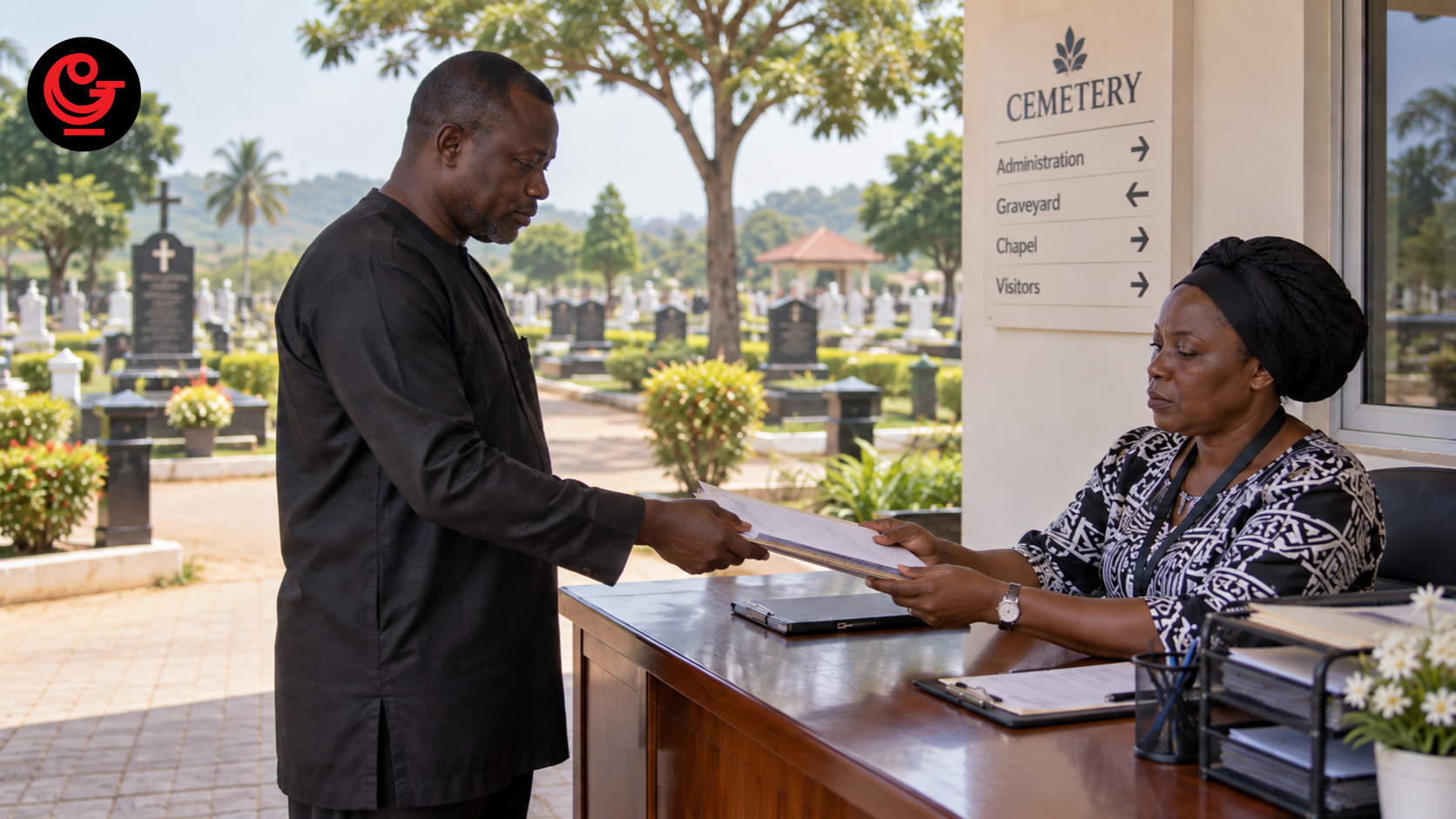
Act 1027 requires the person conducting a burial to inspect both the death certificate and burial permit before proceeding.
The owner or manager of the burial ground or other disposition facility must not allow the burial without receiving the burial permit.
After the burial, the manager must endorse the permit with the required particulars and return it to the District Registrar for the district in which the burial took place.
This means families should keep the permit safe and make sure it reaches the responsible person at the burial facility.
How soon should the death be registered?
Under Act 1027, the District Registrar is required to register a death within 10 days after the death.
A death reported after that period can still be registered, but late-registration provisions apply. After 12 months, written authority from the Registrar is required in addition to the prescribed process and fee.
Families should therefore deal with death registration early rather than leaving the legal documentation until shortly before the funeral.
For the detailed late-registration requirements, refer to our Death Certificate in Ghana guide.
What if the body is being brought to Ghana from abroad?
Diaspora families arranging a burial in Ghana may face a different process.
If a deceased person's body is brought into Ghana from another country, Act 1027 allows the District Registrar for the district where the body will be disposed of to issue a burial permit under specified conditions.
This is separate from the normal registration of a death that occurred inside Ghana.
Families dealing with international repatriation should confirm the complete documentation required for transporting the remains as well as the Ghanaian burial requirements.
Ghana Funeral Services has an Air Freight (Repatriation) category for families seeking providers working in this area.
Can a funeral home obtain the permit for the family?
A funeral director or funeral home may assist a family with practical arrangements and help them understand which documents need to be taken where.
A funeral home may also help deliver documents or collect the permit where the Registry permits this arrangement. Families should confirm the procedure with the relevant District Registrar before relying on a funeral home to act on their behalf.
However, the funeral home does not become the issuing authority.
The official burial permit must still come through the Births and Deaths Registry process.
Where practical support is needed, families can search relevant provider categories on Ghana Funeral Services, including:
Funeral Directors
Funeral Homes
Mortuaries
GFS lists these as separate funeral-service categories that families can search for providers.
This is a useful role for GFS: helping families find service providers without suggesting that private businesses issue government documents.
A simple burial-permit checklist
Before the funeral date approaches, the family can check:
Where did the death occur?
Do we have the correct medical certificate or coroner documentation?
Which Births and Deaths Registry office serves the district where the death occurred?
Has the death been registered?
Have we received the official death certificate?
Have we received the burial permit?
Does the person responsible for the burial or cemetery know who will receive the permit?
Have copies of important family documents been stored safely?
Keeping these administrative tasks together can prevent confusion later.
From legal documentation to funeral planning
A burial permit is only one part of organising a funeral.
Once the legal steps are underway, families may still need to agree on the funeral date, prepare a budget, communicate with relatives, organise service providers and prepare funeral materials.
The Funeral Planner Guide can help families organise these practical next steps.
Other GMP tools can then support the funeral journey through:
Funeral Announcement;
Funeral Programme;
The permit makes the burial legally possible, whereas good planning helps the family manage everything around it.
What families should remember
For a death occurring in Ghana, do not begin by searching for a separate burial-permit application at a District Assembly.
Begin with the death-registration process.
Obtain the appropriate medical or coroner documentation, go to the Births and Deaths Registry in the district where the death occurred, and complete the registration.
The District Registrar then issues the death certificate and the burial permit according to Act 1027.
In practical terms, to obtain a burial permit in Ghana:
Get the medical cause-of-death certificate or coroner's report, register the death at the appropriate Births and Deaths Registry office, and collect the burial permit issued by the District Registrar.
Keeping that sequence clear can make one difficult administrative responsibility easier to manage during an already demanding time.
Written by David Owusu Asante
Related Articles
Funeral guest management in Ghana: Seating, protocol, and crowd control
Browse the post to know more and explore detailed insights on this topic.
Read MoreFuneral Day Logistics in Ghana
Browse the post to know more and explore detailed insights on this topic.
Read More