

Funeral day logistics explained for families in Ghana
May 28th 2026, 12:00 am
When the Funeral Day Finally Arrives
On the morning of a typical funeral in Ghana, the family house is rarely quiet. Chairs are being arranged. Canopies are being checked. Family elders are receiving guests. Families and friends of the deceased arrive from various destinations, sometimes from abroad.
This is the day everyone has prepared for. However, it can also become stressful if the logistics for the funeral are not clearly planned.
Funeral day logistics cover the practical organisation of the funeral ceremony itself. It includes timing, transport, seating, protocol, food, ushers, donations, announcements, photography, crowd control, and communication.
A respectful funeral not only concerns the programme but also the order, clarity, and care.
Why Funeral Day Logistics Matters
Funerals in Ghana are moments of family unity, cultural respect, and public remembrance. They often bring together relatives, church members, work colleagues, friends, community leaders, chiefs, queen mothers, neighbours, and diaspora family members.
Because of this, funeral days can become large and complex.
A small delay at the morgue can affect the church service. A missing usher can cause seating confusion. Poor communication can leave guests unsure about where to go after the burial. Therefore, the family must treat logistics as an important part of honouring the deceased.
Good logistics help the family:
Keep the funeral programme on time.
Welcome guests respectfully.
Reduce confusion among mourners.
Support elderly family members and VIP guests.
Manage donations and condolences properly.
Make the day less stressful for the bereaved family.
Funeral Day Logistics Ghana: Key Areas to Plan
1. Confirm the Funeral Day Timeline
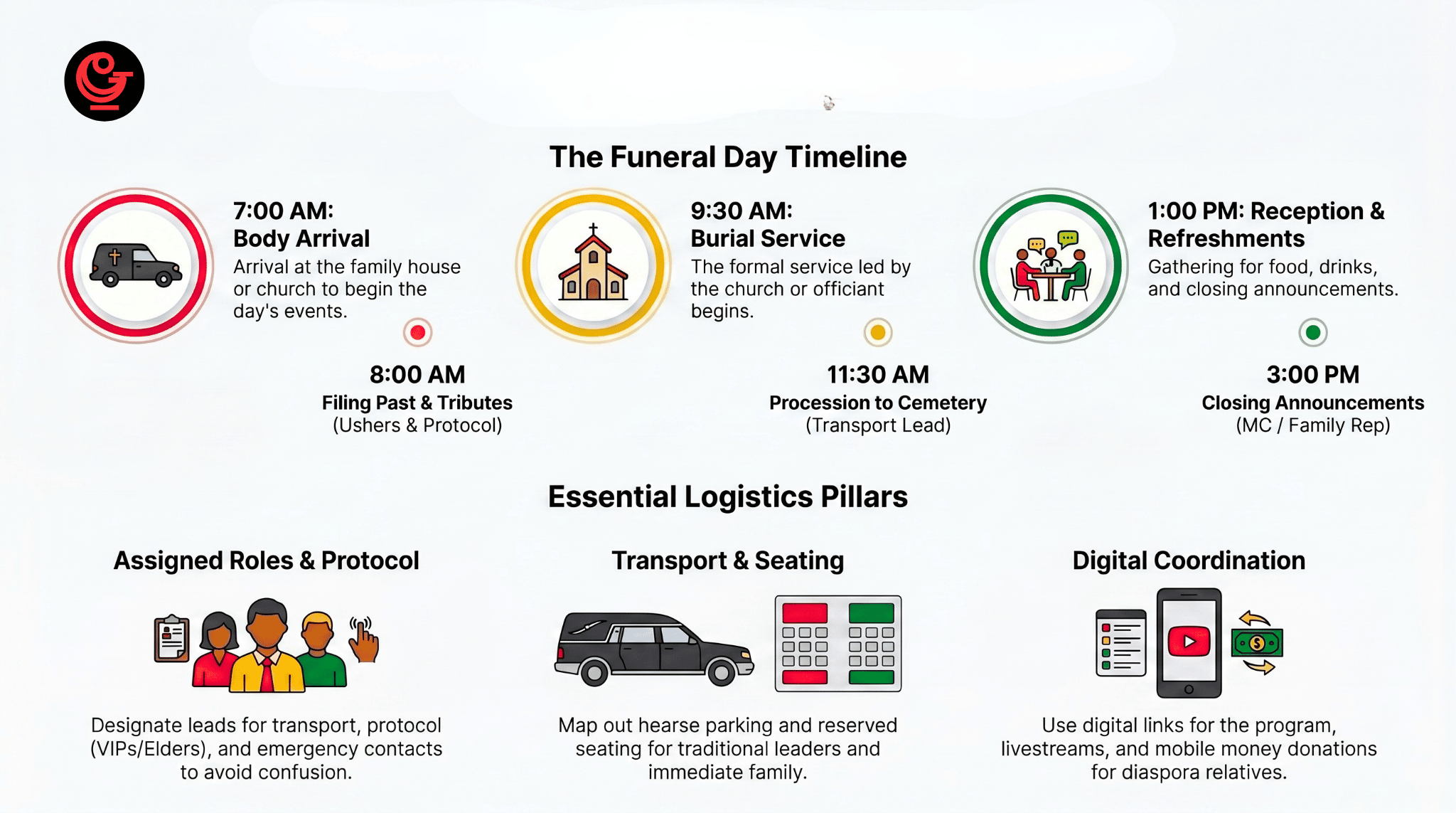
The funeral day timeline should be agreed upon before the day itself. This includes the time for body preparation, arrival at the family house, church service, burial, reception, thanksgiving, and any final family gathering.
A simple timeline may look like this:
No | Time | Activity | Responsible Person |
1 | 6:00 am | Family and committee arrival | Funeral committee |
2 | 7:00 am | The body arrives at the family house or the church | Funeral home contact |
3 | 8:00 am | Filing past and tributes | Ushers and protocol team |
4 | 9:30 am | Burial service begins | Church or officiant |
5 | 11:30 am | Procession to the cemetery | Transport lead |
6 | 1:00 pm | Reception and refreshments | Catering lead |
7 | 3:00 pm | Closing announcements | MC or family representative |
The times may change depending on the family’s tradition, church, mosque, community, or cemetery rules. Still, having a written plan helps everyone work from the same page.
2. Assign Clear Roles Before the Day
One common mistake is assuming that “someone will handle it”. On the day of the funeral, every major task needs a designated person.
Important roles include:
Family representative: speaks on behalf of the family when decisions are needed.
Funeral committee chair: coordinates the full day.
Transport lead: manages hearses, family cars, buses, and parking.
Protocol lead: handles chiefs, elders, clergy, VIPs, and special guests.
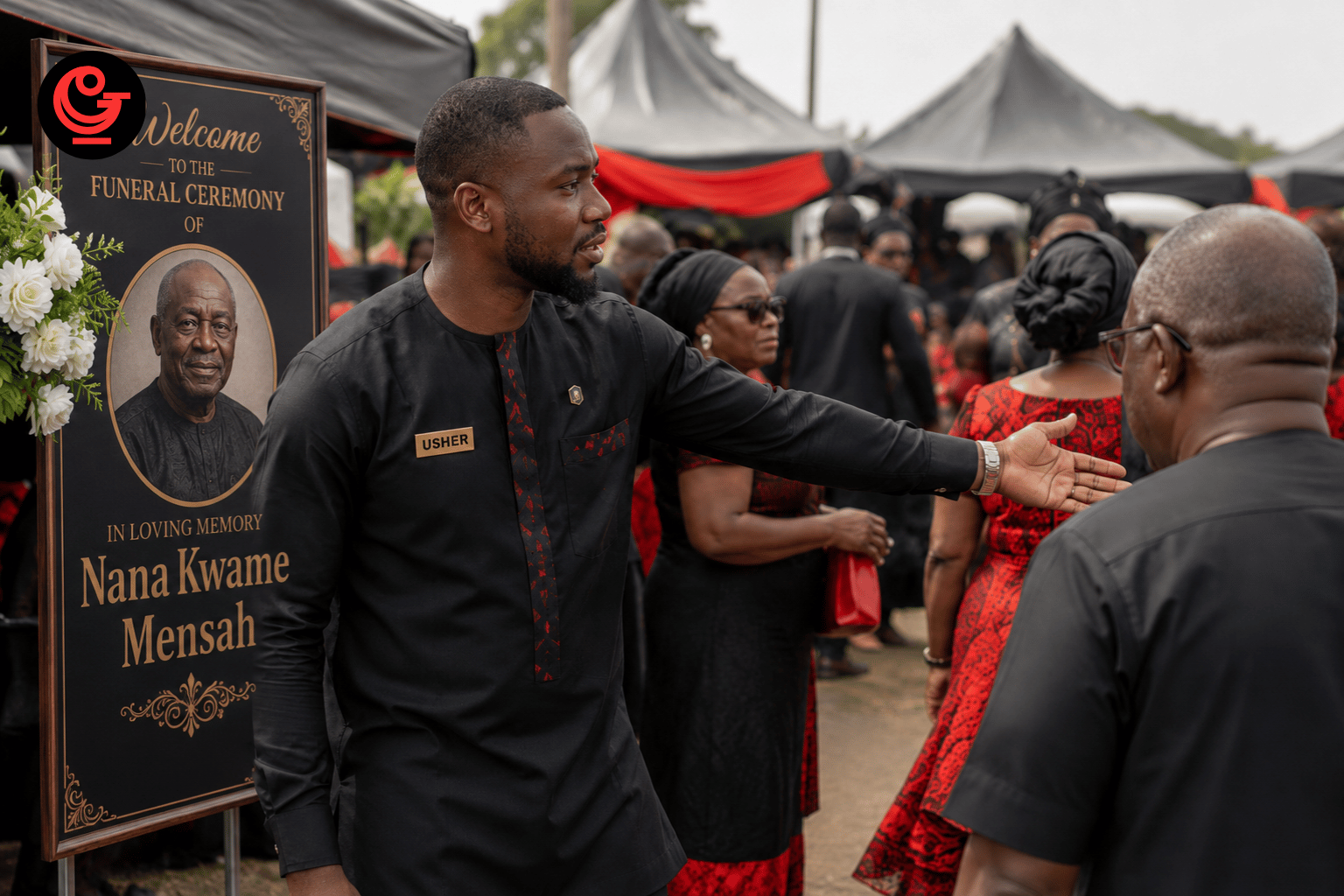
Ushering team: guides guests to seats and locations.
Donation team: records cash, envelopes, and mobile money donations.
Media team: handles photos, videos, livestreams, and sound.
Food and refreshment lead: works with caterers and servers.
Emergency contact person: handles urgent issues calmly.
These roles should be written down and shared through WhatsApp before the funeral day.
3. Manage Transport, Parking, and Road Movement
Transport can affect the whole funeral day. In Ghana, some guests may travel long distances. Others may arrive in groups by bus, private cars, or hired vehicles.
Families should plan:
Where the hearse will arrive and park.
Where family cars will wait.
How elderly guests will move from service to burial.
Where buses can park without blocking the road.
Who will guide cars at the venue?
Whether police or traffic support is needed for a large funeral.
4. Prepare Seating and Protocol Arrangements
Seating is sensitive in Ghanaian funerals. It shows respect. It also prevents confusion.
The family should reserve clearly marked seating for:
Immediate family.
Chief mourners.
Elders.
In-laws.
Clergy or officiants.
Traditional leaders.
Work colleagues or associations.
Special delegations.
Elderly guests.
In communities where chiefs or queen mothers attend, the protocol team should confirm expectations early. In addition, the MC should know the order of acknowledgements, so important guests are not forgotten.
5. Keep the Funeral Programme Easy to Follow
A clear funeral programme helps the ceremony move smoothly. It should include the order of service, hymn numbers, tribute order, burial details, reception location, and family acknowledgements.
However, printed programmes can run out. Some guests may also misplace them.
This is where digital sharing helps. Families can use Ghana Memorial Products to create a funeral page where key information is available through one link. This makes it easier to share updates on WhatsApp with relatives at home and abroad.
6. Organise Donations and Condolences Properly
On the funeral day, many guests will want to support the family. Some will bring envelopes. Others may want to send mobile money or contribute from abroad.
A donation team should be assigned to:
Receive envelopes.
Record names and amounts where appropriate.
Keep donations safe.
Separate church, family, association, and personal contributions.
Confirm digital donations.
Prepare a simple report after the funeral.
A digital Donation Link can make this easier for diaspora family members and friends who cannot attend in person. It also helps the family keep records more clearly.
7. Prepare for Food, Water, and Guest Comfort
Food and refreshment planning should match the expected number of guests and the family’s budget. In Ghana, refreshments may range from water and soft drinks to full meals, depending on the family, location, and tradition.
The food team should confirm:
Number of expected guests.
Serving point.
Water supply.
Waste bins.
Servers.
Special meals for elders or clergy.
Backup plan if attendance is higher than expected.
Comfort matters. A well-organised funeral does not need to be expensive. It needs to be thoughtful.
8. Use Digital Tools to Keep Everyone Informed
Funeral communication can easily become scattered. One person may share the wrong time. Another may send an old poster. A diaspora relative may miss a livestream link.
A digital funeral page can reduce this problem. It can keep all important details in one place, including:
Funeral date and time.
Venue and burial location.
Funeral programme.
Livestream link.
Memorial photos and tribute page.
GPS grave location after burial.
With Ghana Memorial, families can move from funeral-day communication to lasting remembrance. The funeral is a moment, but the memory should continue.
Order Brings Peace on a Difficult Day
A funeral day in Ghana carries deep meaning. It is a day of honour, farewell, family unity, and public remembrance. But without clear logistics, the family can become overwhelmed.
By planning the timeline, assigning roles, managing transport, preparing seating, organising donations, and using digital tools, families can reduce confusion and protect the dignity of the day.
Ghana Memorial Products helps families share funeral details, receive condolences, collect donations, preserve tributes, and keep memories alive beyond the funeral day.
For more step-by-step help, families can continue with the Funeral Planner Guide.
Related Articles
Funeral guest management in Ghana: Seating, protocol, and crowd control
Browse the post to know more and explore detailed insights on this topic.
Read MorePhysical and Online condolence books in Ghana: Preserving words of comfort
Browse the post to know more and explore detailed insights on this topic.
Read More